
Microneedling for Acne: What an Early Clinical Study Actually Found

By Alexander E. Bonato, MD — Board-Certified in Internal Medicine · Medically reviewed July 2026.
TL;DR: Microneedling over active acne has long been treated as off-limits — the fear being that dragging tiny needles across breakouts would spread bacteria and make things worse. An early clinical study challenges that: in a small pilot, microneedling did not worsen acne and was associated with meaningful reductions in both inflammatory and non-inflammatory lesions. The honest caveats matter, though — it was a 12-person study with no control group, funded by the company that makes the device, and it excluded severe cystic acne. So this is promising and myth-busting, not a proven acne cure. Here's the full, straight story.
A while back I convinced myself I could cut my own hair. Not a trim — a full, confident, “how hard can it be” overhaul, armed with a $19 clipper kit and the specific arrogance of a man who has watched other people get haircuts. Ten minutes in, I had carved a bald racing stripe above my right ear that no guard length could explain. I spent the next three weeks wearing a hat indoors and telling people I was “trying something.” The lesson, as always, was that confidently doing a thing the wrong way is worse than not doing it at all.
Which is a weirdly perfect segue into today's topic, because the world of acne treatment is full of confident wrong answers. I'm a board-certified physician (internal medicine by training) who practices aesthetic medicine at Bonato MD Aesthetics here in Medford, and one of the most stubborn “rules” I hear repeated — by patients, by influencers, sometimes by other providers — is that you must never, ever microneedle skin that has active acne on it. Today we're going to actually look at the evidence behind that rule, because a clinical study went and tested it. If you're dealing with breakouts anywhere around Medford, Ashland, or Grants Pass, this one's worth reading to the end, caveats included.
The Rule Everyone Repeats: “Never Needle Active Acne”
Here's the conventional wisdom, and it sounds reasonable: acne involves bacteria (the famous Cutibacterium acnes), so if you roll a cartridge of tiny needles across an active pimple, you'll drag that bacteria all over the face and light up a bunch of new breakouts. Microneedling is even formally contraindicated over active acne in some places, including parts of the U.S.
The problem is that this fear was built mostly on assumption, not data. For one, C. acnes isn't some invading villain — it's one of the most common bacteria living peacefully on healthy skin. The idea that acne is simply a “C. acnes infection” you can spread like a cold is an outdated, oversimplified model. And critically, until recently, nobody had actually run a study to see what happens when you microneedle over active acne. The rule was a vibe, not a finding.
What the Study Actually Did
The study I'm leaning on is Alqam and colleagues (2023), published in Skin Health and Disease. Researchers took people with active acne and — bravely — microneedled their faces on purpose to see whether it helped or hurt. The setup:
● 15 people enrolled, 12 finished the study (three dropped out).
● They were split into two groups: one got three sessions four weeks apart; the other got four sessions two weeks apart, using an FDA-cleared microneedling pen.
● On angry, inflamed pimples, the clinicians used a targeted “stamping” technique to the lesion itself.
● Everyone was assessed by a trained grader who counted lesions before and after, plus a two-month follow-up.
Notably, they screened out the most severe, nodular-cystic acne. So from the start, this was a study of mild-to-moderate acne, not the worst cases.
The Results: Fewer Lesions, No Flare-Up
Two things happened, and both matter. First, the myth didn't come true: microneedling did not trigger a spread of acne or a wave of new breakouts, and skin redness didn't worsen over the study. Second, lesions actually went down. In the main group of nine people:
● Inflammatory lesions (the red, angry ones) fell about 58% from baseline at the two-month follow-up.
● Non-inflammatory lesions (blackheads and whiteheads) fell about 48%.
● This reduction was statistically significant for that group, and every participant said they'd recommend the treatment.
The proposed reason isn't “killing bacteria” at all — it's that the controlled micro-injury kicks off normal wound healing and skin remodeling, helps unclog follicles, and calms the local inflammatory process. Which is a genuinely different way to think about treating acne.
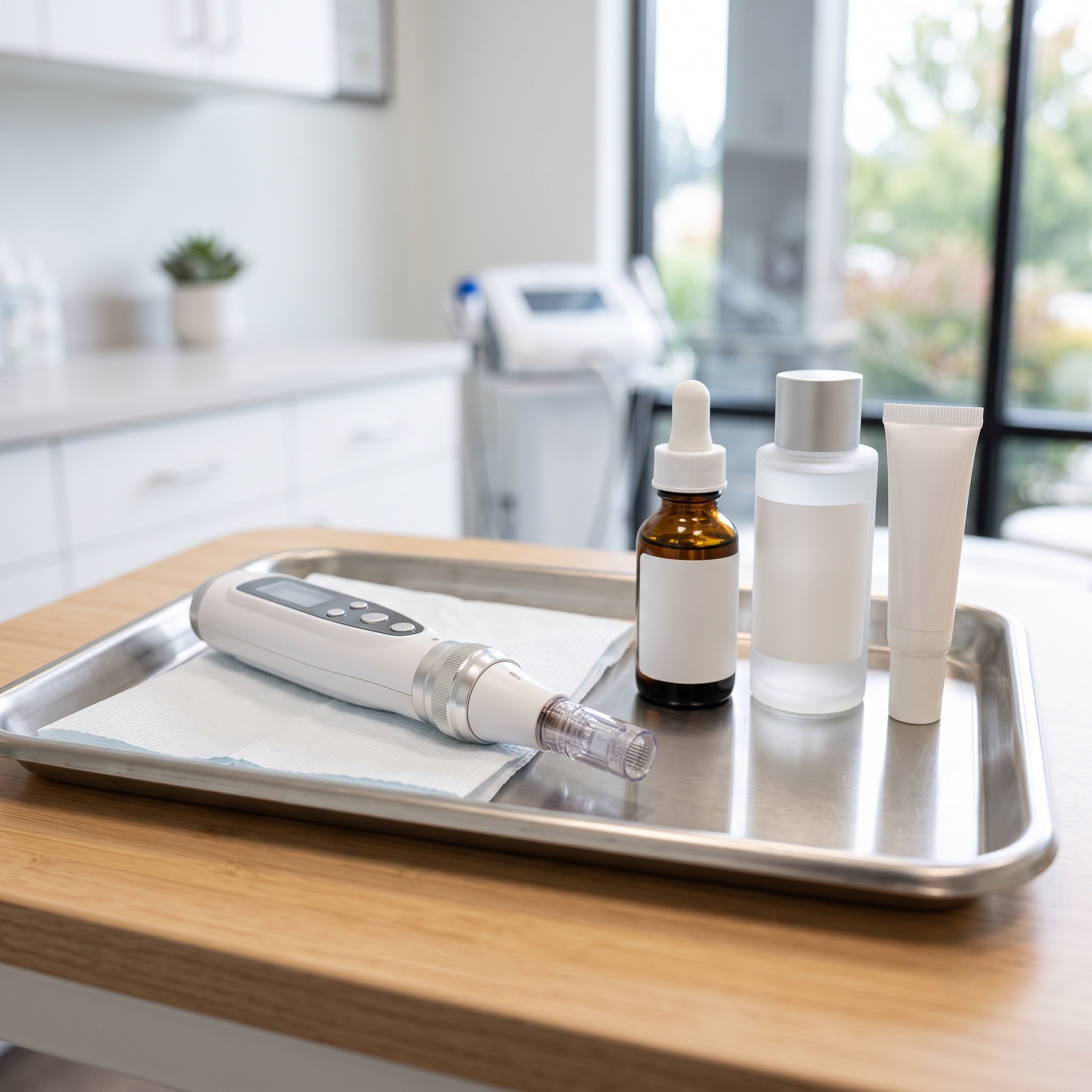
Now the Honesty Part (Please Read This)
This is the section a good salesman skips and a good doctor doesn't. The results above are encouraging, but you should know exactly how much weight they can hold:
● It was funded by the device's manufacturer, and all three authors work for that company. That doesn't make the data fake, but industry-funded studies of a company's own product deserve extra skepticism — and independent replication.
● There was no control group. With only 12 people and nobody to compare against, we can't fully separate the treatment's effect from other factors.
● Everyone also used a full skincare regimen (cleanser, sunscreen, moisturizer) during the study, so some of the improvement may come from that, not the needling alone.
● The second group had only three people and its results were not statistically significant.
● Severe cystic acne was excluded, so none of this speaks to the worst cases.
So the honest takeaway is narrower than the headline: this is a small, early, industry-funded pilot that challenges the old “never needle acne” rule and suggests microneedling can be a well-tolerated option for the right person. It is not proof that microneedling is a superior acne treatment, and anyone who tells you otherwise is getting ahead of the data.
How It Compares to the Usual Acne Playbook
Part of why a gentler option is appealing is that the standard heavy hitters come with real trade-offs. Long-term antibiotics can drive resistance and wipe out helpful skin bacteria along with the unhelpful. Oral isotretinoin is genuinely effective but carries significant considerations — dryness, strict pregnancy-prevention requirements, and monitoring. Those tools have their place, and for moderate-to-severe or scarring acne they're often the right call.
Microneedling's appeal is that it works with your skin's repair process rather than shutting down oil glands or reaching for systemic medication — without damaging the sebaceous glands or the skin's microbiome. For mild-to-moderate acne in someone who wants to avoid systemic drugs, that's an interesting option worth discussing. Curious what else fits your skin? See our in-office skin treatments.
Is Microneedling for Acne Right for You?
You might be a reasonable candidate if you have mild-to-moderate inflammatory or comedonal acne, you'd prefer to avoid or supplement systemic medication, and you have realistic expectations about a series of treatments. You're probably not the right fit if you have severe, nodular, or cystic acne (that needs a different, often medical, plan), if you have an active skin infection, or if you're looking for a one-session miracle. See our microneedling page for more info.
This is exactly the kind of call that should be made in person, not from a blog. A short evaluation sorts out whether microneedling, a medical acne plan, or a combination makes the most sense for your skin. We can map that out together.
Frequently Asked Questions
Will microneedling make my acne worse or spread it?
That was the long-standing fear, but in this pilot it didn't happen — microneedling didn't trigger new breakouts and redness didn't worsen. That said, it's one small study, and severe cystic acne wasn't tested. For inflamed or severe acne, this is a decision to make with a clinician, not something to try at home.
Does it hurt?
We apply a numbing cream first, so most people find it very tolerable — more “buzzy vibration” than pain. On individual inflamed lesions the technique is a bit more targeted, but it's brief.
How many sessions would I need?
In the study, people improved with either three sessions spaced four weeks apart or four sessions spaced two weeks apart. In practice we'd tailor the number and spacing to how your skin is behaving — acne is not one-size-fits-all.
Can I microneedle at home for my acne?
I'd steer away from DIY needling over active acne. The study used a controlled, FDA-cleared medical device, trained technique, sterile conditions, and proper depth — the opposite of a drugstore roller on a bathroom counter. Doing it wrong is how you actually cause the problems people worry about.
Is this better than Accutane or antibiotics?
We don't have evidence to claim it's better — the study didn't compare them head-to-head. Think of microneedling as a different tool that may suit milder cases or people wanting to avoid systemic medication. Severe or scarring acne often still needs the medical heavy hitters.
Let's Figure Out Your Skin — Here in Southern Oregon
I may not be allowed near my own hair with clippers ever again, but I can help you build an acne plan that's grounded in what the evidence actually supports — including being honest when the evidence is still early. At Bonato MD Aesthetics we see patients from Medford, Ashland, and Grants Pass, and we'll give you a straight answer about whether microneedling, a medical acne plan, or a mix is the smart move for your skin.
No hype, no scare tactics, no miracle promises. Book a consultation and let's take a look together.
References
1. Alqam ML, Jones BC, Hitchcock TM. Study to determine the safety and efficacy of microneedling as an effective treatment for acne vulgaris. Skin Health and Disease. 2023;3(5):e264. https://doi.org/10.1002/ski2.264
