
PRP for Hair Loss: We Can Wake Follicles Up. We Can't Raise the Dead.

By Alexander E. Bonato, MD — Board-Certified in Internal Medicine · Medically reviewed July, 2026.
TL;DR: PRP hair loss treatment (platelet-rich plasma) is a minimally invasive option for androgenetic alopecia and female pattern hair loss that uses growth factors spun down from your own blood to stimulate thinning-but-living hair follicles. A 2023 best-practice review in The Laryngoscope concluded that PRP has a therapeutic role in hair restoration, and the meta-analyses it summarizes report meaningful gains in hair density and thickness — most consistently when treatments are done in a series roughly four weeks apart. It is not a cure, the underlying studies are still catching up on standardization, and it can't revive follicles that are already gone. For the right candidate, though, it's one of the better-supported non-surgical options available.
Last month I decided, with the unearned confidence of a man who owns exactly one toolbox, that I would build a raised garden bed from a YouTube tutorial. I am a physician. I have sutured human tissue. Surely I could drive a screw into a plank of cedar. Ninety minutes later I was sitting in my driveway, sweating through my shirt, staring at a structure that looked less like a planter and more like modern art titled Regret. One corner was a full inch higher than the other three. I had somehow stripped every screw, glued my glove to the wood, and developed a splinter in a location I will not disclose. My wife looked out the window, took a slow sip of her coffee, and closed the blinds. Respect.
The point of that humiliating little vignette is this: doing something sort of right, without following the actual proven method, gets you a wobbly, lopsided disaster. And nowhere is that more true than in hair restoration — a field absolutely crawling with wobbly, lopsided nonsense. So while I am a genuine hazard with a cordless drill, I am — thankfully for everyone involved — a board-certified physician (internal medicine by training) who practices aesthetic medicine at Bonato MD Aesthetics here in Medford, and hair loss is one of the things I'm actually good at. Today we're going to talk about platelet-rich plasma — PRP — for hair, what the peer-reviewed evidence honestly does and doesn't say, and whether it's worth your time and money if you're in Medford, Ashland, or Grants Pass and watching your hairline stage a slow retreat.
The Bald Truth: Why Hair Bails on You
Let's name the villain first. Androgenetic alopecia (AGA) — male pattern baldness — and female pattern hair loss (FPHL) are the medical terms for “my hair is thinning and I have feelings about it.” They're extraordinarily common, they're driven largely by genetics and hormones, and they can take a real swing at your quality of life, your confidence, and how you feel every time you walk past a mirror in bad lighting.
For a long time the options felt grim. On one end, you rub foams and swallow pills and hope. On the other end sits the nuclear option: hair transplantation, which is effective but invasive, comes with the potential for surgical complications, and carries a price tag that can make your bank account file for emotional support. PRP slots into the middle of that spectrum — minimally invasive, done in the office, using your own blood. Over the last decade it's gotten genuinely popular. But “popular” and “proven” are not the same word, so let's do the thing the internet almost never does with an aesthetic treatment: look at the actual evidence, including its warts.
Where This Information Comes From (And Some Honesty Up Front)
Everything below leans on a 2023 paper by Levin and Spiegel in The Laryngoscope titled “Does Platelet-Rich Plasma Have a Therapeutic Role in Hair Restoration?”
Here's me being straight with you, because a physician's name is on this post and I'd rather you trust me than be impressed by me: that paper is a best-practice summary — a short review that pulls together five previously published systematic reviews and meta-analyses. It is not one giant original mega-study, and it's not a single systematic review that pooled every patient into one clean dataset. When you see the impressive-sounding figure of “56 studies and 2,114 patients,” that's the combined count across those five separate reviews — and the authors specifically note there was overlap between them, meaning some of the same studies (and patients) got counted more than once. That's not a scandal; it's just how a review-of-reviews works. But you deserve to know the number isn't as clean as marketing copy elsewhere on the internet makes it sound.
Why does that matter? Because it changes “PRP is bulletproof, settled science” into the more honest “multiple independent reviews point the same direction, which is genuinely encouraging, but the individual studies underneath are often small and not yet standardized.” Both of those can be true. Let's get into what they found.
The Science, Simplified: What Is PRP, Actually?
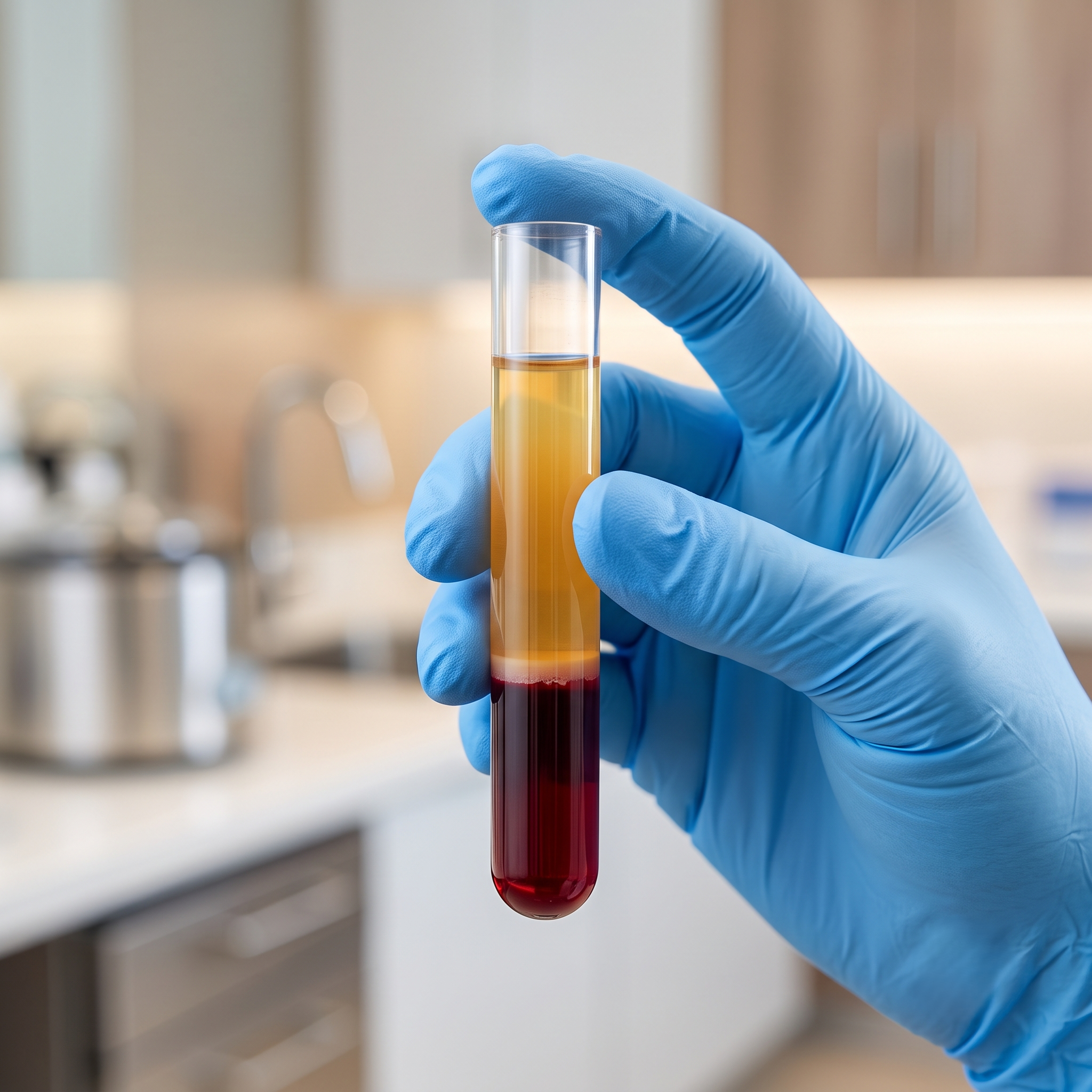
Picture your blood as a sold-out concert. The red blood cells are the enormous general-admission crowd — necessary, but not who we're here for. The platelets are the VIPs with backstage passes, because they're loaded with growth factors: little biological signaling molecules that, among other jobs, can nudge blood-vessel formation (angiogenesis) and cell proliferation.
PRP is an autologous substance, which is a fancy way of saying it comes from you. We draw a small amount of your blood, spin it in a centrifuge to separate and concentrate those VIP platelets, and then inject that concentrate into the thinning areas of your scalp. The theory: those growth factors act like tiny, aggressive foremen yelling at sluggish, miniaturizing hair follicles to wake up and get back to work.
Quick reality check: yes, we draw your blood that day, and no, you can't bring it from home in a mason jar — and honestly, the fact that people ask means the question is a good one, because it gets at exactly why PRP works: it has to be yours.
Does It Actually Work? What the Reviews Found
Here's the part where my cynical, evidence-loving brain gets pleasantly surprised. Across the five reviews Levin and Spiegel summarized, the direction of the findings is consistent — PRP outperformed placebo or baseline for hair metrics in most analyses. Breaking it down honestly:
● It grows hair in most studies. In the review by Cervantes et al., 10 of 12 included studies showed therapeutic effectiveness of PRP for androgenetic alopecia by increasing terminal hair density and diameter.
● It measurably increases density. A meta-analysis by Giordano et al. — pooling 6 studies and 117 patients — found a mean difference of 17.90 more hairs per square centimeter in PRP patients versus controls (p = 0.004).
● It thickens the strands, too. A systematic review and meta-analysis by Gupta et al. (23 studies, including 7 randomized controlled trials) found PRP beat placebo on terminal hair density, hair diameter, and epidermal thickness.
● It works for women. A review by Zhou et al. focused entirely on female pattern hair loss — 42 studies, 776 female patients — and found PRP efficacious for improving hair density compared with both control groups and baseline.
● The reviewers' bottom line: PRP does have a therapeutic role in hair restoration.
Encouraging, right? It should be. But now the fine print, because this is the stuff a good doctor tells you and a good salesman doesn't.
The Honest Caveats (Read This Part)
I could stop at “the studies are great, book now!” But that would make me exactly the kind of aesthetics huckster I can't stand. So here's what the same evidence also says:
● Quality is a mixed bag. In the Gupta review, only about 26% of the included studies were rated high quality. A lot of the underlying research is small and underpowered.
● There's no single agreed-upon recipe yet. Spin speeds, number of sessions, platelet concentration, and whether to use an activator all varied study to study. Every review called for larger, rigorous, double-blind randomized trials.
● It only works on follicles that are still alive. PRP stimulates existing, sluggish, miniaturizing follicles. If an area of your scalp has been smooth and shiny for a decade, those follicles are likely gone, and no growth factor is resurrecting them.
● It's a series, not a magic single visit. Managing expectations is half the job.
None of that means PRP doesn't work. It means PRP is a legitimately promising, well-tolerated, still-maturing treatment. That's a real thing you can make a smart decision about — which is more than you can say for most of what gets sold under a ring light.
Curious how PRP fits alongside our other regenerative options?
The Blueprint: How PRP Is Actually Done Right
Remember my catastrophic garden bed? The lumber was fine. My technique was the disaster. PRP is the same — the difference between a good result and a waste of money is almost entirely in the protocol. The reviews actually give us useful guidance here:
● How the blood is spun matters. Mao et al. found hair density was lower with a single-spin method than with a double-spin method; Cervantes et al. recommended a double-spin approach (first spin around 1,700 rpm, second around 2,500 rpm).
● Concentration matters. The reviews clustered around a platelet enrichment of roughly 3–6× your baseline count — concentrated enough to matter, not so aggressive it's counterproductive.
● Frequency and consistency matter most. The consensus is multiple treatments spaced about four weeks apart — commonly once a month for at least three months to start, then periodic maintenance. Gupta et al. specifically found evidence favoring more frequent (every-4-week) sessions.
This is exactly why a random “PRP add-on” at a discount pop-up is a gamble. The device, the spin protocol, and the treatment schedule are the whole ballgame — and getting them right is a medical decision, not a retail one.
We also offer complementary in-office options for scalp and skin health.
Is PRP Right for You? Honest Candidacy
You're likely a good candidate if:
● You have thinning hair, a widening part, or a softly receding hairline where hair is getting finer — not fully absent.
● You're in the earlier-to-middle stages of androgenetic alopecia or female pattern hair loss.
● You want a minimally invasive option and you're realistic about it being a series plus maintenance.
You're likely not a great candidate if:
● The area has been completely bald and smooth for years (dead follicles don't respond).
● You're looking for a one-and-done permanent fix (that's not what this is).
● You have certain blood, platelet, or clotting conditions, or other medical factors we'd need to screen for at consultation.
The only way to know for sure is an actual scalp evaluation — which, conveniently, is exactly what a consultation is for.
Frequently Asked Questions
Does getting needles in my scalp hurt?
I'm not going to insult you and call it a spa massage — it's needles in your scalp. But we use very fine needles and numbing techniques to keep it manageable, and the side effects noted across the literature were generally mild and temporary: some pain at the site, mild headache, and itching. Most patients tolerate it far better than they expect walking in.
How many sessions will I need?
The evidence supports starting with a series — commonly a minimum of about three sessions spaced roughly one month apart — followed by maintenance sessions a few times a year. Hair biology is slow; you're coaching follicles, not flipping a switch, so consistency over several months is what pays off.
When will I see results, and are they permanent?
Hair grows slowly, so give it months, not days — improvement in density and thickness tends to show over a series and with maintenance. And no, it's not permanent in the “one treatment forever” sense. Androgenetic hair loss is a progressive, lifelong condition; PRP helps manage it, which means ongoing maintenance to hold your gains.
Can I use someone else's blood? My cousin has incredible hair.
Absolutely not, and I love that you asked. PRP is autologous — it must come from your own blood. Injecting someone else's is a genuine medical emergency and a fast track to me losing my license. We're harnessing your growth factors.
Is PRP better than a hair transplant or medication?
They're different tools. Transplantation is more invasive and more expensive but relocates actual follicles. Medications and PRP work by supporting the follicles you still have. Many patients do best with a combination strategy, which is a conversation we'd have based on your specific pattern and goals — not a one-size-fits-all answer.
Am I too far gone for this?
Maybe — and I'll tell you honestly at your consult rather than take your money and shrug. PRP needs living follicles to work with. If you're thinning, you're likely a candidate. If you've been shiny-smooth in an area for years, that region probably won't respond, and I'd rather point you toward options that will.
Let's Talk About Your Hairline — Right Here in Southern Oregon
I may be a certified menace with a power drill and a sworn enemy of flat-pack furniture, but I know precisely how to evaluate a thinning scalp and build a PRP protocol that reflects what the evidence actually supports — the right preparation, the right concentration, and the right schedule.
If you're tired of watching your hair quietly downsize and you want a minimally invasive, honestly-explained option, come see us at Bonato MD Aesthetics. We serve Medford, Ashland, and Grants Pass, and we'll give you a straight answer about whether PRP is a smart move for your hair — including if it isn't. No pressure, no peppermint-scented internet serums, no hype. Just an evaluation and a plan.
Ready to find out if you're a candidate?
References
1. Levin M, Spiegel JH. Does platelet-rich plasma have a therapeutic role in hair restoration? Laryngoscope. 2023;133(4):719–721. https://doi.org/10.1002/lary.30564
