
NOUVADerm™ 1927nm Thulium Laser Skin Rejuvenation in Medford, Oregon
Physician-led, non-ablative fractional laser resurfacing for sun damage, uneven tone, and rough texture.
Medically reviewed by Alexander Bonato, MD — October 2026
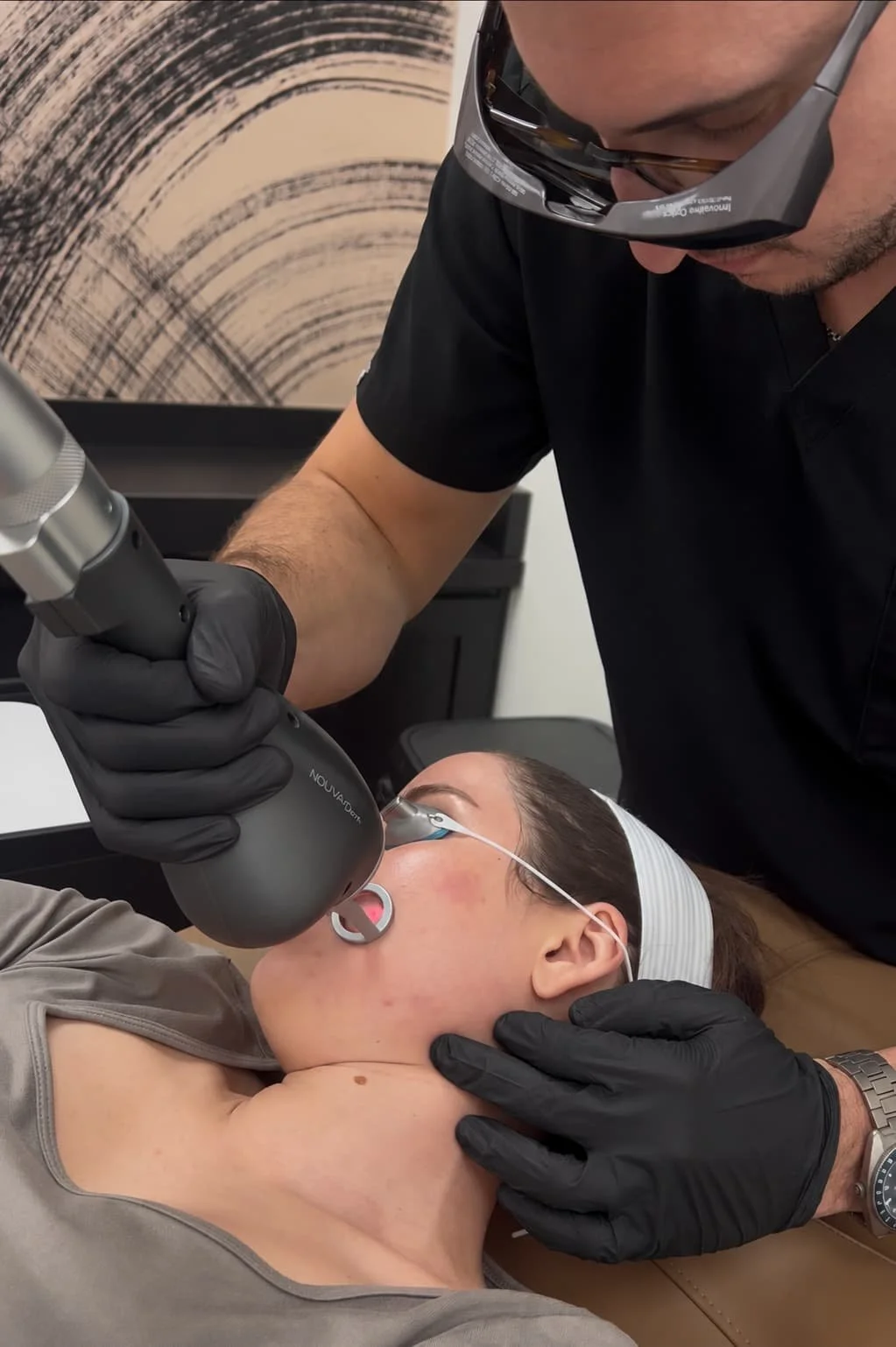
Smoother, More Even Skin With Less Downtime Than Ablative Lasers
NOUVADerm™ is a 1927nm thulium fiber laser. It is a non-ablative fractional laser: it treats the surface layers of your skin in a pattern of microscopic zones and leaves the skin between them untouched, so healing is faster than with ablative resurfacing like CO2. Your skin sheds the treated surface over about a week, and new collagen builds over the following weeks.
It is well suited to sun damage, brown spots, uneven tone, and rough or dull skin. It is a resurfacing treatment, not a facelift, and it asks for a few days of visible healing and careful sun protection.
Every treatment at Bonato MD Aesthetics is performed by Dr. Alex Bonato, MD — board-certified in Internal Medicine by the American Board of Internal Medicine. You'll always be treated by Dr. Bonato himself, from consultation through treatment. Serving Medford and Southern Oregon. Meet Dr. Bonato →

How Much Does Laser Skin Rejuvenation Cost in Medford?
Pricing depends on how intensive the treatment needs to be. NOUVAGlo is a lighter NOUVADerm™ 1927nm treatment for overall radiance and tone, and a single session is $600. A full-face series at higher settings, for more significant sun damage, pigment, or texture change, is $3,000 for three sessions.
At your free consultation Dr. Bonato will tell you honestly which one your skin actually needs. Some concerns respond well to a single light treatment; others genuinely require a series, and we would rather set that expectation up front than sell you one session that under-delivers.
NOUVAGlo single session: $600 · Full-face series of three: $3,000 · Free consultation
Why does thulium cost more than CO2? You're comparing three treatments to one. The thulium series ($3,000) is three full-face sessions that rebuild collagen progressively with days of downtime, not weeks. CO2 ($2,500) is a single deeper session. More sessions, more physician time — that's the difference.
NOUVAGlo ($600): approximately $86 due at treatment, followed by six monthly payments of approximately $86 through Cherry. 0% APR financing subject to approval; exact payment amounts and terms are provided by Cherry.
NOUVADerm Full-Face Series of Three ($3,000): approximately $429 due at treatment, followed by six monthly payments of approximately $429 through Cherry. 0% APR financing subject to approval; exact payment amounts and terms are provided by Cherry.
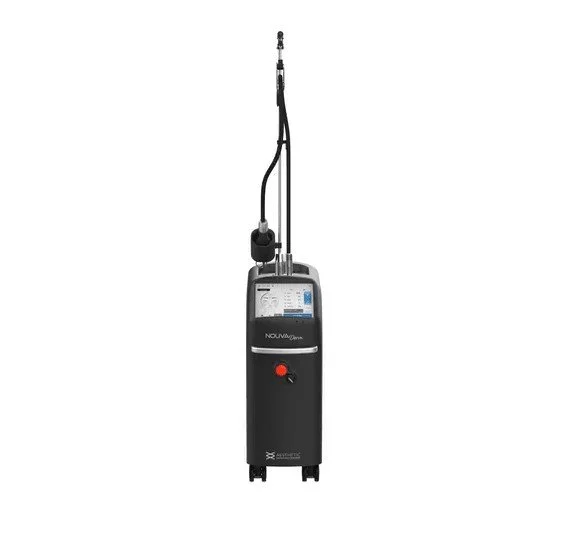
What is NOUVADerm™ (How 1927nm Works)
The NOUVADerm™ is a 1927nm thulium fiber laser. The number is the wavelength of the light. At 1927nm, light is absorbed very strongly by water in the skin, so the energy is spent near the surface. It reaches the epidermis and upper dermis, roughly 200 to 300 microns deep, instead of going deep.
The laser delivers that energy as thousands of microscopic treatment zones. Each zone is a tiny column of controlled thermal injury. The skin between the zones is left intact and helps the area heal quickly. The surface layer stays intact too, which is what makes this a non-ablative treatment.
Over the next several days, your skin pushes the treated tissue to the surface, including pigment from sun-damaged cells, and sheds it. Your body then builds new collagen and elastin in the treated skin. That is why the skin looks bronzed and slightly rough for several days, and why the finished result is smoother and more even.
How 1927nm Compares With Other Resurfacing Lasers
Lasers differ mainly in how deep they go, and depth is a trade between results and recovery.
Ablative lasers (CO2, Er:YAG): remove microscopic columns of skin and reach into the dermis. They produce the most improvement for deep wrinkles and scars, with the most downtime and the highest risk of infection, scarring, and lasting pigment change.
Deeper non-ablative lasers (such as 1550nm): go further into the dermis, which suits scars and deeper lines. They typically carry more risk of pigment darkening and longer healing.
1927nm thulium (NOUVADerm™): stays superficial. It is aimed at pigment, sun damage, and skin quality, with a recovery measured in days instead of weeks.
If your main concern is deeper wrinkles or scarring, Dr. Bonato will tell you honestly when a different laser is a better fit. Read more: The 1927nm thulium laser explained
Considering a deeper treatment? Explore CO₂ laser resurfacing and its recovery requirements.

What NOUVADerm™ Can Improve
Sun damage and brown spots — NOUVADerm is a great option for laser brown spot removal, softening sun spots and uneven pigment with minimal downtime. Can a thulium laser treat actinic keratosis?
Uneven tone and dullness — a brighter, more even complexion
Rough or uneven texture — surface roughness and enlarged-looking pores
Fine lines — fine surface lines, especially around the eyes. Deeper wrinkles respond better to deeper lasers
Mild acne scars — shallow marks and early texture change. Deeper or more established scars usually need a deeper approach, and Dr. Bonato will say so
Results build over several weeks, and most people need more than one session. The goal is meaningful improvement, not perfection. A resurfacing laser does not tighten loose skin or replace lost volume.
Each treatment is customized by Dr. Bonato. Energy and density are set for your skin tone, your concern, and the area treated.

Who Is a Good Candidate?
NOUVADerm™ is a good fit if you want to improve sun damage, uneven pigment, or rough texture and you can accept about a week of visible healing. It is a poor fit for deeper wrinkles or significant scarring, which usually need a deeper treatment.
Skin Tone Matters
Post-inflammatory hyperpigmentation, or PIH, is darkening after treatment. It is an important complication to consider, particularly in darker skin tones.
That is why skin tone changes the plan, not necessarily whether you can be treated:
Types I–II: standard settings
Type III and above: a skin-priming routine for several weeks before treatment (sun protection plus a prescribed pigment-calming regimen may be recommended), and gentler settings
Types V–VI: treatment is considered case by case, with conservative settings, mandatory priming, and the understanding that for some people another approach is a better fit
Most published studies were done in lighter to medium skin tones, so there is less evidence in the darkest skin tones. Dr. Bonato will assess your skin type and go through your options at your consultation. Check out more information on Thulium laser treatment for skin of color.
When We'll Ask You to Wait
We will reschedule or choose a different treatment if you have:
An active infection or cold sore in the treatment area
A recent tan or sunburn — we ask for strict sun avoidance for 2 to 4 weeks before treatment
Pregnancy or breastfeeding
An open wound or broken skin barrier in the area
A flare of eczema, psoriasis, or another inflammatory skin condition in the area
Other situations call for a conversation first. They do not automatically rule out treatment: a history of keloids, recent or current isotretinoin (Accutane), photosensitizing medications, immune suppression, prior radiation to the area, or a history of skin cancer in the area. Tell Dr. Bonato about any history of cold sores. Whether you need an antiviral before NOUVADerm is his clinical call, based on your history.
If you are unsure whether you are a candidate, book a complimentary NOUVADerm™ consultation to have your skin assessed and a plan designed for you.
What Healing Looks Like
NOUVADerm™ has less downtime than ablative lasers, but it is not downtime-free. This is a typical course.
The timeline:
Right after — redness, warmth, and mild swelling, like a moderate sunburn. Cool compresses and a bland ointment help.
Days 1–3 — skin stays red, warm, and tight. Swelling is highest in the first 24 to 48 hours and settles by day 3 to 5. No makeup.
Days 2–5 — the treated tissue rises to the surface, so the skin looks bronzed and feels like fine sandpaper. This is the treatment working. Moisturize often and don't scrub.
Days 5–10 — the bronzed texture flakes and sheds on its own. Skin may look patchy for a few days. Makeup is usually fine once peeling is done. After a light NOUVAGlo session, makeup is usually fine the next day. After a higher-intensity treatment, wait until peeling is complete and the skin has re-epithelialized — unless you are using makeup specifically made for post-laser skin.
Week 2 and beyond — skin is pink and smooth and the pink fades. New collagen continues to build for 3 to 6 months.
Most people are back to normal activities within a day or two, with makeup and exercise on a short delay. Redness lasts about 1 to 7 days, and longer with more aggressive settings. Treatment of the neck and chest heals more slowly than the face.
Plan your treatment around your calendar and the sun. Most people book it when they can have a week without big events and can stay out of direct sun.
Results and How Many Treatments
Early improvement shows as the bronzing sheds, in the first one to two weeks. Collagen remodeling continues for about three months after your last session. Most plans are a series of 3 treatments about 4 to 6 weeks apart, depending on your concern and skin tone. Dr. Bonato will recommend a number at your consultation. Conditions driven by sun exposure can return, so results last longest with daily sunscreen.


Preparing for Treatment and Caring for Your Skin Afterward
Preparation and aftercare protect your result and lower your risk of dark spots. You receive full written instructions when you book. The highlights:
Before:
Start 4 weeks ahead: daily mineral sunscreen (iron-oxide formulas if you are Fitzpatrick III or above), strict sun avoidance, and no tanning beds
Skin priming if Dr. Bonato prescribes it, which is standard for Fitzpatrick type III and above
Stop retinoids and exfoliating products 7 days before
Tell us about medications, especially isotretinoin, blood thinners, and anything that makes you sun-sensitive
After:
Keep skin moist and cleanse gently, patting dry
Don't pick, scratch, or scrub — let the bronzed texture shed on its own
Mineral sunscreen starting day 2, and daily for at least 3 to 4 months
No sweating, saunas, steam rooms, or hot tubs for the first 48 to 72 hours
Restart retinoids and active products only when the treated skin has healed, peeling and sensitivity have resolved, and Dr. Bonato has cleared you. Your written plan gives the timing for your treatment intensity and skin.
Call us for increasing pain, blisters, pus, fever, or darkening you did not expect. Early treatment of dark spots makes a difference
What to Know Before You Decide
NOUVADerm™ has a good safety record, and it carries real risks that are worth knowing about:
Expected: redness, mild swelling, bronzing, dryness, and peeling, as described above
Dark spots (PIH): the most common problem, more likely in darker skin tones and with higher settings. It usually responds to topical treatment but can take months to fade
Cold sore flare: Treatment can reactivate cold sores. Tell Dr. Bonato about your history so he can decide whether antiviral prevention is appropriate.
Acne-like breakouts: uncommon, and usually temporary
Infection or scarring: rare. Scarring was not reported in the published 1927nm studies reviewed
Dr. Bonato reviews the full list of risks, the alternatives, and your questions with you before anything is signed.
Alternatives Worth Considering
Depending on your skin and goals, other options may fit better: prescription topicals and daily sunscreen, a chemical peel such as the VI Peel, IPL, microneedling or radiofrequency microneedling, or a deeper laser for scars and deeper wrinkles. Dr. Bonato will talk through what makes sense for you, including doing nothing.

Pair With Other Treatments
Other treatments may address different concerns. Their suitability and timing are discussed individually.
-
![]()
VI Peel
To further refine texture and tone
-
![Biostimulators]()
Sculptra® or Biostimulators
For deeper, structural rejuvenation
-
![MICRONEEDLING]()
Microneedling
Discuss microneedling for selected texture and acne-scar concerns.


-
![]()
"I’ve seen Dr. Bonato multiple times now for laser (Nouvaderm), and neurotoxin treatments, and I couldn’t be happier with my results. My skin looks and feels incredible — I’ve genuinely never received so many compliments about how “glowy” and refreshed my complexion is."
Bonnie S.
-
![]()
"I have seen Dr Bonato three times for NouvaDerm procedures. His office is very clean, appealing, and inviting. Dr Bonato explains the procedure in depth, provides excellent care, and ensures after care is understood. I cannot recommend him enough! This procedure really helped my mental health by boosting my self esteem and overall skin appearance. Thank you, Dr B!"
Christina P.


NOUVADerm Treatment Examples
NOUVADerm Treatment Examples
This gallery includes Dr. Bonato’s patients and manufacturer-supplied examples. The source is identified for each case. Individual results vary.

Dr. Bonato’s patient — individual results vary.

Dr. Bonato’s patient — individual results vary.

Dr. Bonato’s patient — individual results vary.

Dr. Bonato’s patient — individual results vary.

Dr. Bonato’s patient — individual results vary.

Dr. Bonato’s patient — individual results vary.

Dr. Bonato’s patient — individual results vary.

Manufacturer-supplied example — treatment performed by another provider. Individual results vary.
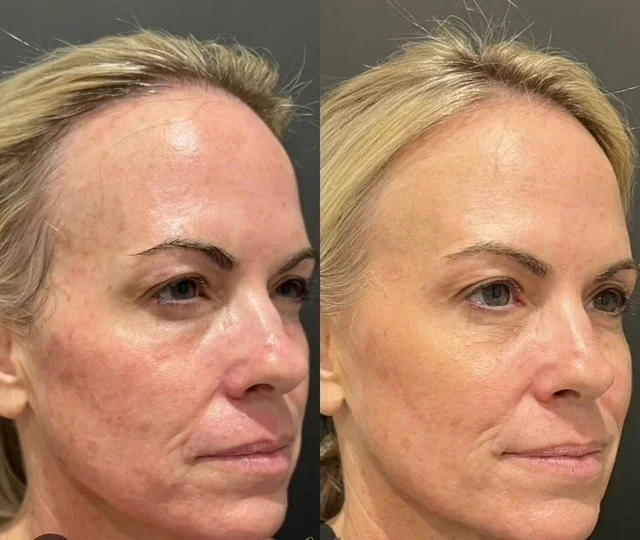
Manufacturer-supplied example — treatment performed by another provider. Individual results vary.

Manufacturer-supplied example — treatment performed by another provider. Individual results vary.

Manufacturer-supplied example — treatment performed by another provider. Individual results vary.

Manufacturer-supplied example — treatment performed by another provider. Individual results vary.
QUESTIONS? WE HAVE ANSWERS!
FAQs
-
NOUVADerm™ is a 1927nm thulium fiber laser. It is a non-ablative fractional laser, which means it treats the skin in a pattern of microscopic zones and leaves the surface layer and the skin between the zones intact. It targets the water in the upper layers of skin, so it works on pigment, sun damage, and texture without going deep.
-
It is the wavelength of the laser light, measured in nanometers. Light at 1927nm is absorbed very strongly by water in the skin, so the energy stays near the surface instead of going deep. That is why it suits sun damage and pigment and why recovery is shorter than with deeper or ablative lasers.
-
Both are fractional lasers, and some Fraxel models also include a 1927nm wavelength. NOUVADerm is a different device, and what matters most for your result is the settings chosen and the person using it. Dr. Bonato performs every treatment himself.
-
You will see skin shed and look smoother within about one to two weeks, once the bronzed texture has come off. Collagen remodeling continues for roughly three months after your last session, so results keep improving after the surface has healed.
-
Most plans are 3 treatments about 4 to 6 weeks apart. Some concerns respond to a single lighter treatment; others need a series. Dr. Bonato will tell you at your consultation which one fits your skin.
-
A numbing cream is applied before treatment. Most people describe heat and a prickling sensation while the laser is used, and the skin feels like a moderate sunburn for a few hours afterward.
-
Expect redness and warmth for the first few days, swelling that peaks in the first 24 to 48 hours, then a bronzed, sandpaper-like texture that sheds over about 5 to 10 days. Many people go back to work within a day or two, and wear makeup once the peeling is done. Plan around about a week of visible healing.
-
Usually within a day or two. The skin will look sunburned at first and bronzed after that, so some people prefer to take a few days off or schedule treatment ahead of a quieter week.
-
It can be used across a range of skin tones, with settings and preparation matched to your skin. The risk of dark spots afterward rises with skin tone, so Fitzpatrick type III and above start a skin-priming routine weeks before treatment, and types V–VI are treated case by case with conservative settings. Dr. Bonato assesses your skin type at your consultation and will tell you if another approach is a better fit.
-
Yes. Dr. Bonato treats the neck, décolleté (chest), and hands, and other areas of the body can be treated as well, depending on the area and your skin. Skin outside the face heals more slowly, so expect a longer recovery there than on the face, and settings are adjusted for each area. Dr. Bonato will tell you at your consultation which areas make sense for you.
-
It can soften fine lines and mild acne marks. Deeper wrinkles and established scars usually respond better to a deeper laser or another approach, and Dr. Bonato will say so rather than sell you a series that is unlikely to help.

Ready to talk about NOUVADerm?
Book a consultation with Dr. Bonato to find out whether NOUVADerm fits your skin and your goals — or whether another option would serve you better. The consultation is free, and every treatment at Bonato MD Aesthetics is performed by Dr. Bonato himself, from consultation through treatment.