
Microneedling With Tranexamic Acid for Melasma: What the Evidence Really Says

By Alexander E. Bonato, MD — Board-Certified in Internal Medicine · Medically reviewed July 2026.
TL;DR: Microneedling used to deliver tranexamic acid (TXA) into the skin is a well-tolerated, minimally invasive option for melasma, and across several small trials it reliably reduces pigment. But here's the honest wrinkle most articles skip: in the best-controlled study, adding TXA worked no better than adding plain saline — which suggests the microneedling itself may be doing much of the heavy lifting. So this is a reasonable, gentle approach that works about as well as other melasma treatments, not a proven TXA silver bullet. Melasma is also a chronic, manage-it-for-life condition, and it can flare in darker skin if handled carelessly.
I once spent an entire Saturday “fixing” a squeaky door with WD-40. I sprayed the hinge. Still squeaked. I sprayed it again. Still squeaked. By the fourth round I'd emptied half the can, the hallway smelled like a mechanic's garage, and the door squeaked louder than ever — because, as I'd eventually learn, the squeak was coming from the floorboard, not the hinge. I was very confidently treating the wrong thing.
That is melasma in a nutshell, and it's why I wanted to write this one carefully. I'm a board-certified physician (internal medicine by training) practicing aesthetic medicine at Bonato MD Aesthetics in Medford, and melasma is one of the conditions I see people throw money at in exactly the wrong order. One of the trendiest combinations right now is microneedling with tranexamic acid — so let's look at what the evidence honestly shows, including the part the marketing leaves out. If you're in Medford, Ashland, or Grants Pass and fighting stubborn facial pigment, this is for you.
First, What Melasma Actually Is
Melasma is a chronic pigment condition — patches of brown-to-gray discoloration, usually on sun-exposed parts of the face, most often in women with medium-to-deeper skin tones. It's not just “too much pigment”; it involves a tangle of hormones, sun exposure, inflammation, and blood-vessel changes. That complexity is exactly why it's stubborn, why it relapses, and why the wrong aggressive treatment can make it worse rather than better.
The long-standing gold-standard treatment is a triple-combination cream (hydroquinone, a retinoid, and a mild steroid). It works, but it can cause irritation and, with overuse, its own pigment problems — so people understandably look for gentler, more durable alternatives. Enter tranexamic acid and microneedling.
The Two Players: Tranexamic Acid and Microneedling
Tranexamic acid (TXA) started life as a medication to reduce bleeding, but it turns out to calm the overactive pigment signaling that drives melasma. Taken as a pill it can work, but oral TXA has body-wide considerations (stomach upset, and it's not for everyone). So clinicians started delivering it locally into the skin instead.
Microneedling creates thousands of microscopic channels in the skin. Two things come from that: it nudges the skin's own repair and remodeling process, and it creates temporary pathways that help topical products get in — a delivery trick sometimes called mesoneedling. Pair them up and the pitch is obvious: use microneedling to drive TXA exactly where the pigment problem lives.
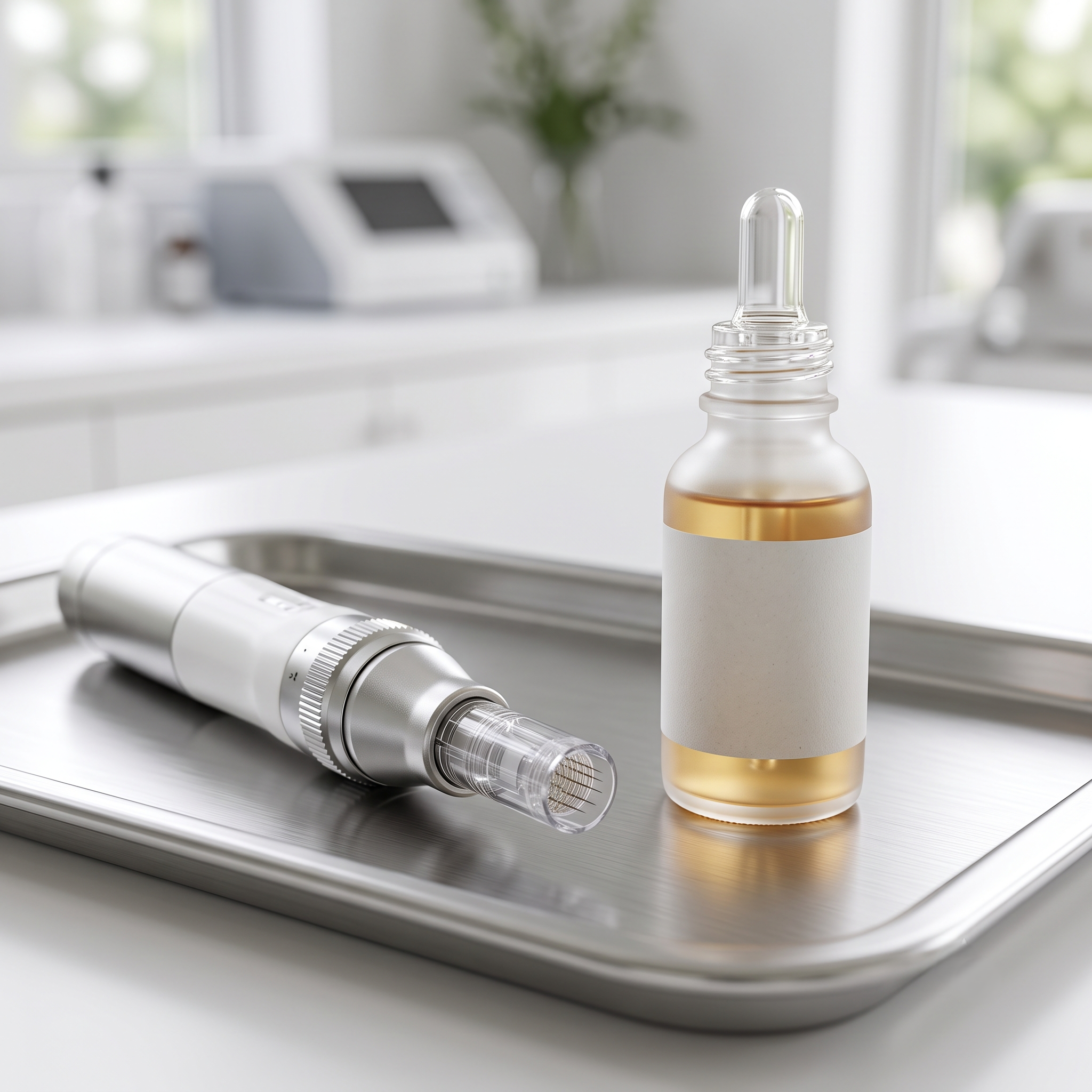
What the Evidence Shows — and the Catch
The best current summary is a 2026 scoping review (Dhaliwal and colleagues) that pulled together eight clinical trials of microneedling-delivered TXA for melasma. Two honest headlines come out of it.
Headline one — it works, and it's gentle. Across nearly all the trials, melasma severity scores dropped, patients were generally satisfied, side effects were mild and short-lived (some redness, mild irritation), and results were comparable to other delivery routes like injections. Several studies found patients preferred microneedling to needle injections. For a minimally invasive treatment, that's a solid, reassuring profile.
Headline two — and this is the part that gets left out — the tranexamic acid may not be the hero. In the single best-designed trial (the only double-blind, placebo-controlled one), microneedling with TXA was no better than microneedling with plain saline. Other trials in the review found TXA performed about the same as vitamin C, and about the same as a laser comparison. The review's authors say it plainly: the benefit patients see may come from the microneedling itself rather than from the tranexamic acid added to it.
That doesn't mean TXA is useless — some trials did favor it, and mechanistically it should help. But it does mean the honest claim is “microneedling helps melasma, and TXA is a reasonable thing to deliver with it,” not “TXA is a breakthrough that erases melasma.” Anyone selling the second version is ahead of the evidence.
A Few More Honesty Notes
● The studies are small and mixed. Sample sizes ran from about 20 to 100 people, protocols varied a lot, and most used pigment scores that rely on a clinician's eye — useful, but somewhat subjective.
● Durability data is thin. There's a signal that microneedling-based approaches may hold results better than oral TXA alone, but follow-up in most studies was short. Treat long-term-durability claims with caution.
● Skin of color needs extra care. Melasma disproportionately affects deeper skin tones, and those same skin types are more prone to post-inflammatory hyperpigmentation — meaning an overly aggressive treatment can darken the very spots you're treating. This is a where-you-go-and-who-does-it decision, not a bargain-hunt.
● A cold-sore history matters. Microneedling can occasionally reactivate herpes simplex, so tell your provider if that's you.
Want to see how this fits with gentler in-office options for pigment and skin quality? See our skin-rejuvenation treatments.
So Is It Worth Doing?
For the right person, yes — with clear expectations. Microneedling (with or without TXA) is a legitimately reasonable, well-tolerated melasma option that performs about as well as the alternatives and tends to be comfortable and low-downtime. What it is not is a permanent cure. Melasma is a chronic condition you manage over time — with diligent daily sun protection as the non-negotiable foundation, because unprotected sun exposure will undo any treatment you pay for.
The biggest predictor of a good outcome isn't the exact serum on the needle — it's an accurate diagnosis, a conservative energy/technique choice (especially in deeper skin tones), and a realistic plan. That's the WD-40 lesson: make sure you're treating the actual problem before you spray. A proper skin evaluation is where that starts.
Frequently Asked Questions
Does microneedling with tranexamic acid cure melasma?
No — and be wary of anyone who says it does. Melasma is chronic. This can meaningfully reduce pigment and is well tolerated, but it's a management tool, not a one-and-done cure. Daily sun protection is what keeps results from sliding backward.
If the tranexamic acid might not add much, why use it?
Fair question. Some trials did favor TXA, it has a sensible mechanism, and it's low-risk to include. But the honest framing is that the microneedling is likely doing much of the work — so you shouldn't pay a large premium purely for the “TXA” label.
Is it safe for darker skin tones?
It can be, but skin of color needs a cautious approach because of the higher risk of post-inflammatory hyperpigmentation. The right settings and an experienced provider matter more here than with almost any other treatment. This is not the place to cut corners.
How many sessions will I need?
Most studies ran a series over roughly 12 weeks, with sessions spaced a few weeks apart. Your plan depends on your skin and how the melasma responds — and it usually includes ongoing maintenance and sun protection rather than a fixed finish line.
Does it hurt?
We numb the skin first, and microneedling is generally well tolerated — most people report mild prickling and some temporary redness afterward, not significant pain. It was consistently rated more comfortable than injections in the studies.
Let's Treat the Right Problem — Here in Southern Oregon
I've made peace with the fact that I should never be trusted with a can of WD-40 and a hunch. But I can help you avoid the melasma version of that mistake: throwing treatments at pigment without first nailing the diagnosis and the plan. At Bonato MD Aesthetics we see patients from Medford, Ashland, and Grants Pass, and we'll be honest about what's likely to help your skin — and what's just clever marketing.
Book a consultation and let's build a melasma plan that actually fits your skin — sunscreen included.
References
1. Dhaliwal S, Dhanoa N, Rashid Z. Exploring the effectiveness, tolerability, and safety of the adjunctive use of microneedling with tranexamic acid in the treatment of melasma. Journal of Cosmetic Dermatology. 2026;25:e70763. https://doi.org/10.1111/jocd.70763
