
How Dysport Works: Turning Down the Volume on One Overachieving Muscle
By Alexander E. Bonato, MD — Board-Certified in Internal Medicine · Medically reviewed July, 2026.
TL;DR: Dysport, Botox, and their cousins are all “neuromodulators” — purified botulinum toxin type A that temporarily blocks the nerve signal telling a muscle to contract. Relax the muscle, and the dynamic wrinkle it creates (frown lines, crow's feet, forehead creases) softens. It's not a filler and it doesn't “freeze your face” when it's done well. Effects start within a few days, peak around two weeks, and typically last about three to five months before the muscle wakes back up. It has a wide safety margin and side effects are usually mild and temporary. One honest caveat up front: the newer “higher doses last way longer” research is early and largely industry-funded, so take the biggest numbers with a grain of salt.
I once spent a truly heroic amount of energy trying to stop my own eye from twitching before a wedding I was officiating. Not a medical eye twitch — a stress twitch, the kind that shows up the week you agree to speak in public. I tried everything a reasonable person would: less coffee (failed), more sleep (failed), and finally standing in front of the mirror physically holding my eyelid still with one finger like I was defusing a bomb. The twitch won. I delivered the whole ceremony looking like I was winking at the groom.
The irony is that, in my actual day job, I spend a lot of time turning off overactive facial muscles on purpose — just with something far more sophisticated than a nervous index finger. I'm a board-certified physician (internal medicine by training) who practices aesthetic medicine at Bonato MD Aesthetics here in Medford, and “how does Dysport actually work?” is one of the most common questions I get. So let's take the mystery out of it — what these injections really do, how fast, how long, and where the marketing gets a little ahead of the science.
First: A Neuromodulator Is Not a Filler
This trips up almost everyone, so let's clear it immediately. There are two totally different tools in the injectable world, and they do opposite jobs:
● Neuromodulators (Dysport, Botox, Xeomin, Jeuveau) relax muscles. They soften wrinkles caused by movement — the crease that appears when you frown or squint.
● Fillers (hyaluronic acid gels) add volume. They fill in a line or restore lost fullness, like plumping a deflated cheek.
Same needle, opposite jobs — mixing the two up is a salt-for-sugar situation: same white crystals, very different cake. If your “eleven” lines between your brows deepen when you frown, that's a muscle problem — neuromodulator territory. If you want to see how the volume side works, that's a different conversation on our fillers page.
What Dysport Actually Does to a Muscle
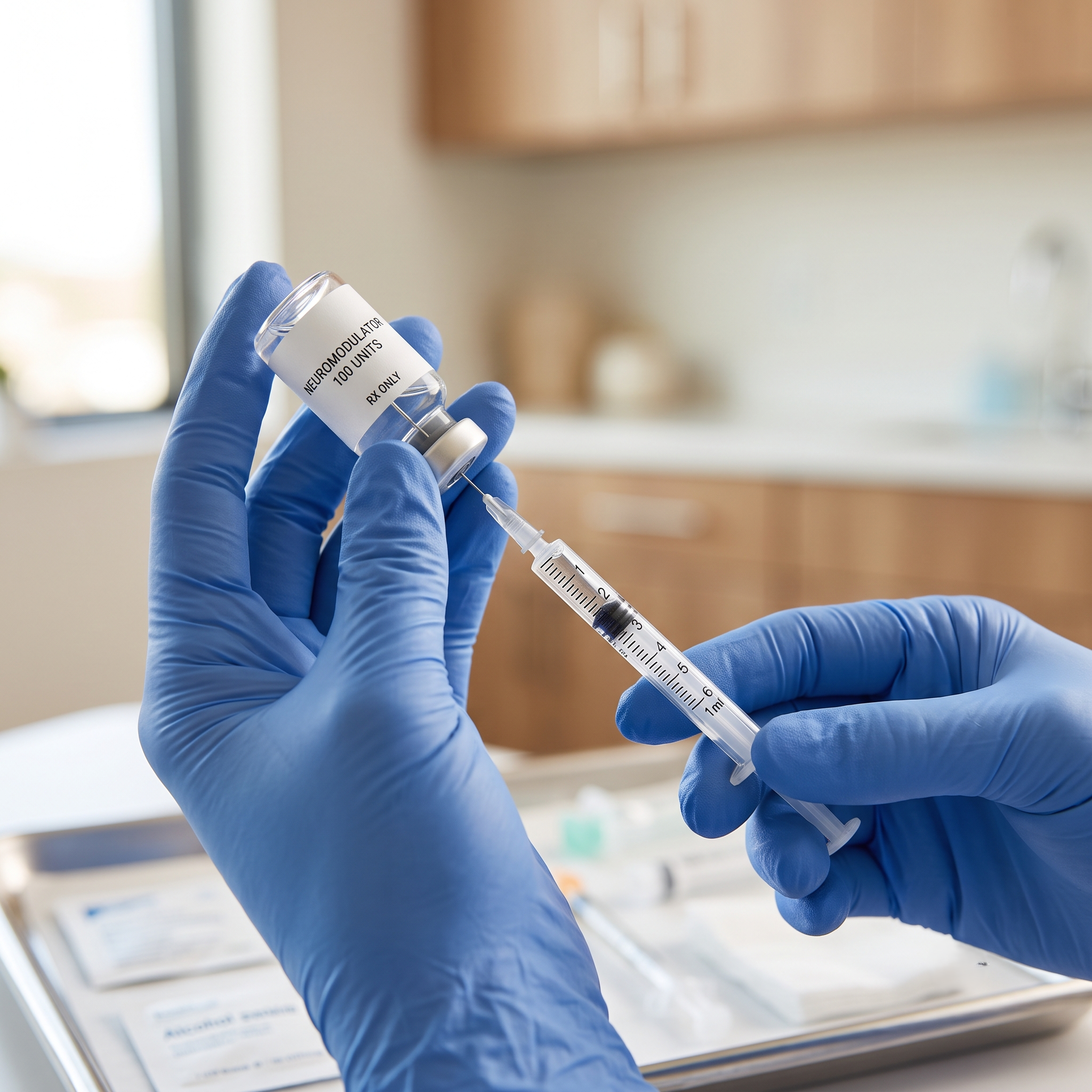
Here's the genuinely cool part, minus the jargon. Every time a muscle contracts, a nerve ending squirts out a chemical messenger called acetylcholine that says, essentially, “squeeze.” Botulinum toxin type A quietly intercepts that message.
Mechanistically, the toxin binds to the nerve terminal, gets pulled inside, and then snips a specific docking protein (SNAP-25) that the nerve needs to release acetylcholine. No messenger released, no “squeeze” signal delivered, so the targeted muscle relaxes. The line it was carving into your skin gets a break — and so does your skin. Crucially, this is reversible: the nerve grows new connections over a few months and function returns completely. Nothing is permanently deadened, cut, or damaged.
Think of it less like “freezing” and more like turning the volume knob down on one overactive muscle while everything around it keeps working normally.
How Fast It Works — and How Long It Lasts
This is the timeline I walk every patient through, because managing expectations is half the job:
● Onset: you'll usually notice something in the first few days — for Dysport specifically, patients often report the start of an effect around two days in.
● Peak: the full result lands at roughly two weeks. So don't panic on day 4 that “it isn't working yet,” and don't judge the final look until the two-week mark.
● Duration: on a standard dose, expect about three to five months before movement gradually returns and you're due for a touch-up. Dysport's on-label duration runs in that same three-to-five-month range.
Duration varies person to person based on muscle strength, metabolism, dose, and how expressive you are (sorry, big talkers). This is a maintenance treatment, not a one-and-done — the muscle always eventually wakes up, which, honestly, is a feature, not a bug: it means a heavy-handed result also fades.
Dose, Units, and Why Guys Need More
A few practical truths. Standard dosing for the frown lines lands around the low-double-digits in “units,” and there's good evidence that going too low (think a token dose) underperforms — you want an actual therapeutic dose, not a homeopathic sprinkle. Men generally need more than women for the same area, simply because they tend to have beefier facial muscles (the corrugators doing your frowning are just bigger).
One important nerd note that matters for your wallet and your safety: “units” are not interchangeable between products. A unit of Dysport is not a unit of Botox. They're formulated and measured differently, so comparing “how many units did you get” across brands is meaningless. What matters is an experienced injector using the right dose for that specific product and your specific anatomy — which is exactly why this is a medical decision, not a Groupon. See our injectable treatments.
Is It Safe? (The Honest Answer)
For cosmetic use in trained hands, botulinum toxin type A has a wide safety margin and a decades-long track record. It doesn't cause lasting changes to your nerves or muscles. That said, no injection is risk-free, and you deserve the honest version rather than a sugar-coated one:
● Common and minor: temporary bruising, swelling, redness, or a little pain at the injection site, and sometimes a headache that settles within a couple of weeks.
● The one everyone worries about — droopy eyelid or brow (ptosis): uncommon, temporary, and usually the result of the product spreading to a muscle it wasn't meant to reach. It resolves as the effect wears off, and careful placement is how a good injector avoids it in the first place.
● Not for everyone: certain neuromuscular conditions (like myasthenia gravis), pregnancy or breastfeeding, an active infection at the site, or a known allergy mean this isn't your treatment. That's what the consultation screens for.
The overwhelming majority of side effects are mild, transient, and self-resolving. The serious stuff is rare and largely a function of technique and dosing — in other words, of who is holding the syringe. If anything ever feels off after a treatment with us, you call us and we take care of you. That part isn't a punchline.
“Can I Make It Last Longer?” — Where the Hype Creeps In
You've probably seen claims that mega-doses make Dysport last nine months or more. There is emerging research suggesting that higher-than-standard doses can extend duration — in some early studies, a roughly 2–2.5× increase in the Dysport dose pushed the median duration toward nine months, without an obvious jump in side effects.
Here's the honesty part, because it matters: those higher-dose studies are small, preliminary, and partly built on conference presentations rather than large finished trials — and the main review pulling them together was funded by a toxin manufacturer, with every author a paid consultant for that company. That doesn't make the data fake, but it's exactly the kind of setup that warrants a raised eyebrow (one you can still raise, because we dosed you conservatively). Standard dosing is what's well-established. Higher-dose protocols are an interesting, individualized conversation — not a proven free lunch, and usually more product means more cost. Real talk beats a marketing slide.
Frequently Asked Questions
Will I look frozen or fake?
Not when it's dosed and placed well. The goal is to soften the lines while leaving you enough movement to look like yourself — expressive, just less etched. “Frozen” is an overtreatment look, not an inevitable one; the permanently-startled forehead is a dosing choice somebody made, not a law of physics.
Does it hurt?
The needles are tiny and the injections are quick — most people describe a brief pinch or pressure, not real pain. If you've ever sat through an eyebrow wax, you are wildly over-qualified for this.
How soon can I go back to normal life?
Basically immediately. There's no real downtime — the main aftercare is staying upright for a few hours and not rubbing the area, so the product settles exactly where we placed it. Translation: skip the hot-yoga headstands and the face-down massage for the afternoon — a set of restrictions most of us find tragically easy to follow.
Dysport or Botox — which is better?
Neither is universally “better”; they're comparably effective, with small differences in how quickly they kick in and how they spread. Anyone who tells you one is flatly superior is usually selling that one. The right pick depends on the area and your goals — a question big enough that it earned its own post (and a real conversation at your visit).
What happens if I stop getting it?
Nothing bad — your muscle simply returns to its baseline movement and the lines gradually come back to where they'd naturally be. You don't “get worse” for having done it; that's a myth that refuses to die, right there next to “cracking your knuckles gives you arthritis.” It just wears off, and you're back where you started.
Let's Talk About Your Frown Lines — Here in Southern Oregon
I may never win a staring contest with my own eyelid, but I can help you get a natural, well-dosed result that softens the lines you're tired of without erasing the face that makes you you. At Bonato MD Aesthetics we see patients from Medford, Ashland, and Grants Pass, and we'll give you a straight answer about whether a neuromodulator, a filler, or a combination actually fits your goals — including when the honest answer is “you don't need much.”
No frozen faces, no upselling, no nine-month promises we can't back up. Book a consultation and let's map it out.
References
1. Satriyasa BK. Botulinum toxin (Botox) A for reducing the appearance of facial wrinkles: a literature review of clinical use and pharmacological aspect. Clin Cosmet Investig Dermatol. 2019;12:223–228. https://doi.org/10.2147/CCID.S202919
2. Kaufman-Janette J, Cox SE, Dayan S, Joseph J. Botulinum toxin type A for glabellar frown lines: what impact of higher doses on outcomes? Toxins (Basel). 2021;13(7):494. https://doi.org/10.3390/toxins13070494
