
Ice-Pick Scars: Why They're So Stubborn, and What Actually Works
By Alexander E. Bonato, MD — Board-Certified in Internal Medicine · Medically reviewed October 2026.
TL;DR: Ice-pick scars are narrow, deep, pit-like acne scars, and they're the hardest type to improve because most treatments work across the surface of the skin instead of down into a pinhole. TCA CROSS, which touches a high-strength acid to the base of each scar, is the most studied focal approach. Across 34 published studies and 937 patients, most people improved, usually over about four sessions. But the studies are mostly small, and the main risk is darker pigment afterward, reported anywhere from 6.7% to over 60%. Compared head to head with lasers, the results are mixed, so none of these options is a sure thing for ice-pick scars.
The built-ins were supposed to take a weekend. That was the estimate. I measured one board eight times and cut it wrong anyway. By the end I'd bought my sixth saw, the guys at the hardware store knew me by name, and math had been formally declared fiction in our house.
What I took from that is that a small, precise problem punishes a big, broad tool. I'm a board-certified physician practicing aesthetic medicine at Bonato MD Aesthetics, and ice-pick scars are exactly that kind of problem. They're a single tiny hole, and most of what we have is built to work on the whole surface. So I went through the research on what actually reaches them.
What an Ice-Pick Scar Actually Is
Acne scars that leave a dent come in three main shapes. Rolling scars are broad and shallow with a wavy surface. Boxcar scars have sharp edges and a flat base. Ice-pick scars are the narrow, deep ones, small pits that look like someone pressed a pin into the skin and kept going. They're tight at the surface and reach deep into the dermis, which is why they can look small and still be stubborn.
Why Most Treatments Struggle With Them
Most scar treatments work across a field. A laser treats a grid across the whole cheek. Microneedling covers the whole area. A peel coats the surface. That's a good fit for broad, shallow problems and a poor match for a pinhole that's deep and narrow, because there's no surface to even out and nowhere for a broad stimulus to concentrate.
It also helps explain a pattern you'll see across the research. In a trial that added poly-L-lactic acid injections after CO2 laser, ice-pick scars improved the least of the three scar types, about a quarter as much as rolling scars (Reference 3).
What TCA CROSS Actually Is
CROSS stands for chemical reconstruction of skin scars. It's a simple idea. Instead of treating the whole face, you treat one scar at a time. A high-strength trichloroacetic acid (TCA), typically 50% to 100%, is touched to the bottom of each scar with a very fine applicator while the skin around it is held taut. Within seconds the scar turns white, a "frosting" that tells you the acid has done its job, and then it's on to the next scar.
That small, controlled injury is the point. Your skin responds by rebuilding collagen at the base of the scar, and over several sessions the bottom of the pit gradually lifts.
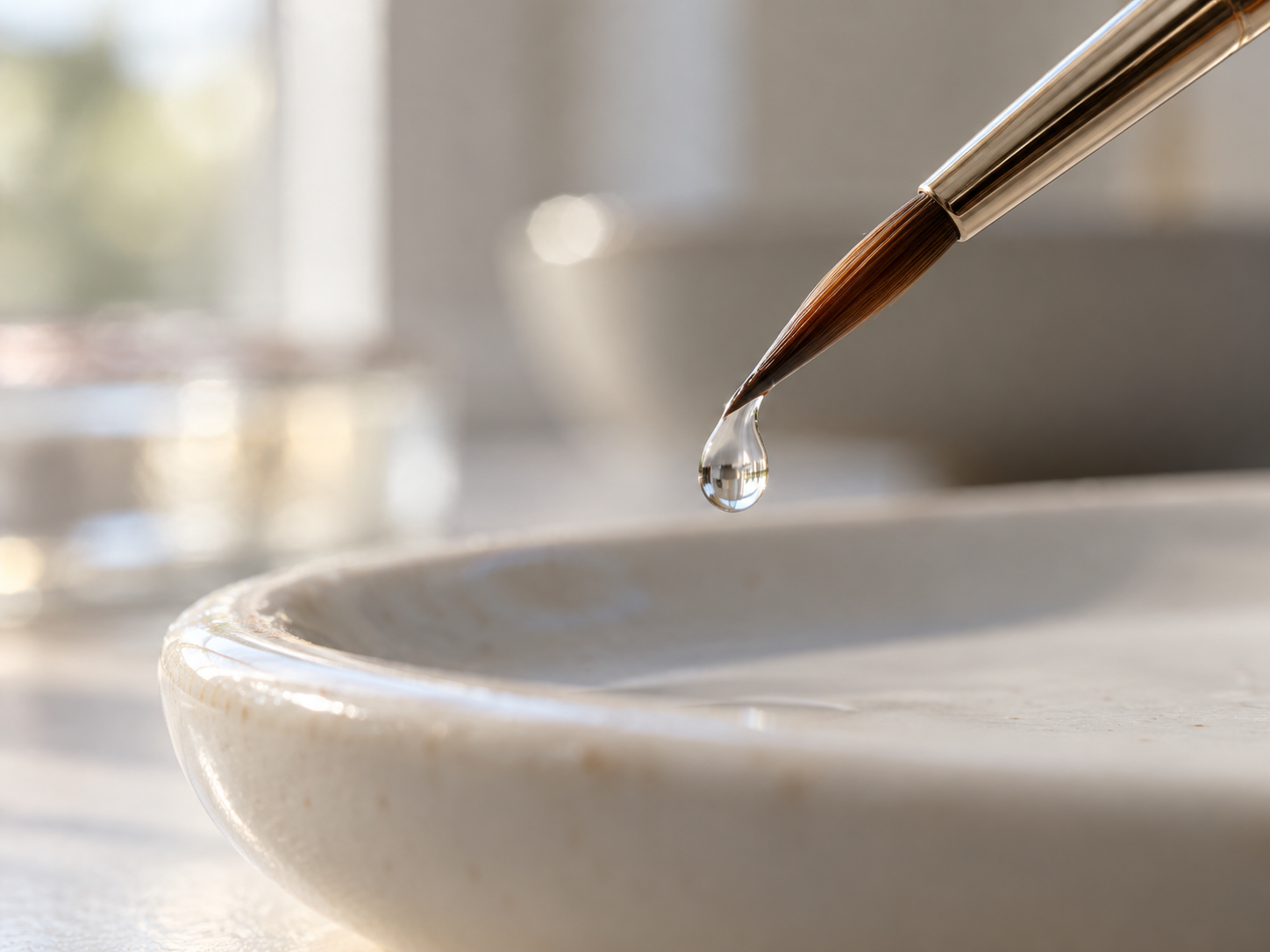
What the acid is applied with turns out to matter. The reviews describe toothpicks and sharpened wooden sticks, fine-gauge needles used like a dropper, and fine paintbrushes. Acid that spills onto the skin around a scar can make the scar worse, and most of the reports of scars getting bigger or deeper involved the less precise wooden applicators. The recommendation across the literature is a fine-gauge needle or a fine paintbrush for control (Reference 1). Which brings me back to the saws. This is a one-measurement, one-cut job, and the whole procedure is basically an argument for precision tools.
What the Studies Show
Two recent reviews map this field, and it's worth knowing what they are up front. One is a systematic review of 34 publications covering 937 patients, mostly Fitzpatrick skin types IV and V (Reference 1). The other is a scoping review of 34 studies published between 2002 and 2025 (Reference 2). They overlap heavily, so treat them as one body of evidence, not two separate confirmations.
In the first review's studies that graded improvement on a quartile scale, 60% to 100% of patients improved by more than 25 to 30%. In nine other studies, 66% to 100% improved by more than 50%. Patients typically rated their own improvement at 50% to 80%. More sessions meant more improvement, with four sessions the most common course and two to four weeks the usual gap. The authors suggest spacing treatments four to six weeks apart, and six to nine weeks for the highest strengths or darker skin, to reduce complications. They conclude CROSS works best for ice-pick scars, then boxcar, then rolling, while noting that few studies broke results down by scar type.
The honest limit is the quality of what sits under those numbers. Most of these studies are small, several have no comparison group, and they used different scales, strengths, and schedules, so the percentages can't be pooled into one clean number. Most of the scoping review's studies come from Asia and the Middle East. Neither review reports a formal quality rating of the individual studies. That makes this a consistent signal that CROSS helps, not proof of exactly how much.
The strength question is a good example of that uncertainty. Trials comparing lower and higher strengths, 70% against 100% and 50% against 80%, found no significant difference in results but more side effects at the higher end (Reference 1). The second review describes 100% as slightly more effective in one of those trials (Reference 2). The two reviews agree on the part that matters: stronger means rougher.
How It Compares With Lasers and Microneedling
Here's where I'd want you to read carefully, because it cuts against the tidy story. In a randomized trial of 28 patients with ice-pick scars, a CO2 laser technique that treated each scar with a single pinpoint pulse worked better than CROSS, and patients were more satisfied (Reference 4). The CROSS group also had more darkening, 64% versus 14%, and more infections, 6 of 14 patients versus 2 of 14.
In a split-face trial of 20 patients, CROSS and a fractional erbium laser gave statistically similar results for ice-pick scars, although the laser was clearly better for rolling scars. The laser side hurt more, while redness and downtime lasted longer on the CROSS side (Reference 1). In another trial, CROSS did better than microneedling for ice-pick scars, while microneedling did better for rolling scars, with no overall difference between the two (Reference 1).
So the fair summary is that CROSS isn't proven better or worse than lasers for ice-pick scars. What it has going for it is that it's focal, simple, and low-cost compared with laser technology (Reference 2). What it costs you is a rougher stretch of skin color and crusting afterward.
The Risks, Plainly
The most common problem after CROSS is post-inflammatory hyperpigmentation, meaning darker patches where the acid went. In the first review's studies it ranged from 6.7% to over 60% (Reference 1). In the second, it appeared in about 20% to 25% of the studies that reported complications, most often at higher strengths and in darker skin types (Reference 2). In the studies that tracked it, it was usually temporary, clearing over about three to six months with strict sun protection and lightening creams. Lingering redness and temporary lighter patches were the next most common. Mild crusting is nearly universal and, in the reviewed studies, came off on its own over roughly five to ten days.
The more serious but rarer problem is a scar getting bigger or deeper instead of better, which the first review found in four publications. One 53-patient study reported it in 17% of patients (Reference 1).
For skin of color, the evidence is thinner than it sounds. Most participants were skin types IV and V, and the first review found a single person with skin type VI, who developed pigment change. The reviews suggest lower strengths, careful sun protection, and longer gaps between sessions for darker skin, but there isn't much data for the darkest skin tones.
None of that is meant to talk you out of it. It's the same list we'd go through in the room before anything touches your skin.
Where CROSS Fits in a Bigger Plan
Most people don't have one scar type. They have a mix: a few ice-pick scars, some boxcar scars, and a broad rolling area. Both reviews land in the same place, which is to match the right tool to each shape instead of asking one tool to do everything. For rolling scars, which are held down by bands underneath, one trial found subcision shrank them more than CROSS did (Reference 1). For the broad surface work, fractional CO2 laser resurfacing and microneedling for acne scars cover the areas CROSS doesn't. CROSS is the tool for the pinholes. It isn't the whole plan by itself.
Frequently Asked Questions
How many sessions will I need?
In the studies, four was the most common number, spaced anywhere from two to six weeks apart, with more sessions generally meaning more improvement. The reviews suggest longer gaps for stronger acid or darker skin. Your own number depends on how many scars you have and how deep they go. It's a series, and unlike my built-ins, it comes with an estimate that's actually accurate.
Does it hurt?
Reports run from mild stinging to intense burning, and stronger acid tends to mean stronger burning. Some of the studies used numbing cream beforehand. It's short, and it's focused on the scars rather than your whole face, which is a small mercy.
What does it look like afterward?
Each treated scar frosts white during the procedure, then turns red, and mild crusting follows. In the reviewed studies the crusts came off on their own over roughly five to ten days. Redness can linger longer than that, and in one trial redness and downtime lasted longer after CROSS than after a laser. Your job is to let the crusts leave on their own schedule.
Is it safe for darker skin?
It's been studied mostly in skin types IV and V, where the reviews found it effective, with pigment change as the main risk and usually a temporary one. For skin type VI there's almost no data. Strength, spacing, and sun protection matter more than usual. This is the question where your actual skin gets a vote, so raise it at the consultation.
Can I combine it with a laser or microneedling?
Combinations are common in the studies, including CROSS with subcision, microneedling, or fractional lasers, and the reviewers favor them for mixed scar types. The caveat is that few trials compare a combination against its parts. In one, adding CROSS to subcision plus PRP added no significant benefit (Reference 1). That's also the lesson of my garage: more tools isn't a plan.
Start With Your Scars, Not the Treatment
If you're in Medford, Ashland, or Grants Pass and you have ice-pick scars, the useful first step is a good look at what kinds of scars you actually have, because that decides what makes sense. Come in and let's look at them together. Bring your questions and bring your history.
Book a consultation and we'll go through your scar types and what the evidence says for each.
References
1. Stratman S, He H. The Use of Chemical Reconstruction of Skin Scars (CROSS) Method With Trichloroacetic Acid (TCA) for Atrophic Scars: A Comprehensive Review on Application Techniques, Adjunct Therapies, and Complications. J Clin Aesthet Dermatol. 2026;19(6):52-67.
2. Melo MGP, de Barros JM, Lima RA. Use of Trichloroacetic Acid in Treatment of Atrophic Acne Scars: A Scoping Review. J Cosmet Dermatol. 2026;25:e71110. https://doi.org/10.1111/jocd.71110
3. Zhou C, Chen W, Zhang L, Luo X, Zhu L, Zhang E, Li K, Qin X. Poly-L-Lactic Acid Combined With CO2 Fractional Laser for the Treatment of Acne Scars. J Cosmet Dermatol. 2025;24(6):e70271. https://doi.org/10.1111/jocd.70271
4. Ahmed R, Mohammed G, Ismail N, Elakhras A. Randomized clinical trial of CO2 LASER pinpoint irradiation technique versus chemical reconstruction of skin scars (CROSS) in treating ice pick acne scars. J Cosmet Laser Ther. 2014;16(1):8-13.
